
01
Quicker access to approved organizational knowledge.
Put AI to work on bounded tasks with evidence, human oversight, and clear operating controls.
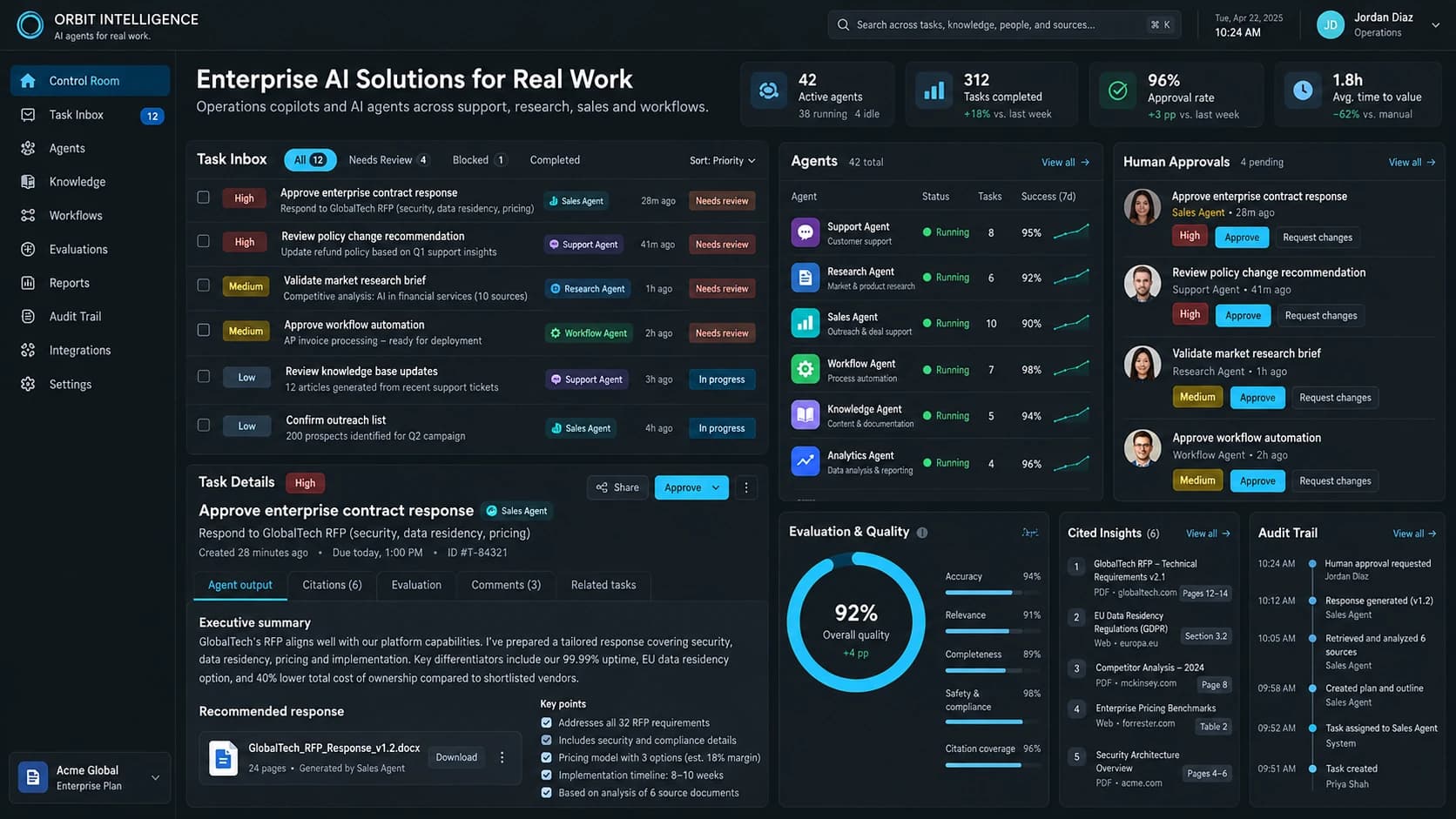


Quicker access to approved organizational knowledge.
Measured quality against real cases before rollout.
Clear review paths for uncertain or sensitive outputs.
A controlled foundation for broader AI adoption.
Define the user, task, allowable data, expected benefit, and decisions that must remain with a person.
Inspect source quality, create representative test cases, and compare a simple baseline with the proposed AI approach.
Implement retrieval or automation with permissions, citations or traceability, review controls, and failure paths.
Track quality, usage, latency, cost, and safety events; adjust prompts, sources, or workflow rules based on evidence.
A compelling demo can hide the hard questions: Which information may the model access? How will a wrong answer be caught? Who owns the workflow after launch? Without a defined task, evaluation set, and operating boundaries, AI investment can create unreliable output, rising cost, and new information risks.
Usually not. Many useful systems combine an existing model with approved data, retrieval, workflow rules, and evaluation. We assess custom training only when the case supports it.
We narrow the task, ground answers in approved sources, test representative edge cases, show uncertainty, and require human review for consequential outputs.
Yes. Data classification, redaction, access controls, and provider configuration are decided before integration. We do not assume every data class is suitable for a model.
We compare task completion, answer quality, review effort, response time, cost, and user trust against a baseline process.
The workflow should offer a safe fallback, such as a source link, a human queue, or a conventional search path, according to the task risk.

Put AI to work on bounded tasks with evidence, human oversight, and clear operating controls.