

Website accessibility checklist for design, content, and QA
A practical WCAG-aligned website accessibility checklist for navigation, forms, content, responsive layouts, testing, and release ownership.
All articles ↗A step-by-step product roadmap guide with an outcome definition, journey mapping, release sequencing, evidence checkpoints, and operating ownership.
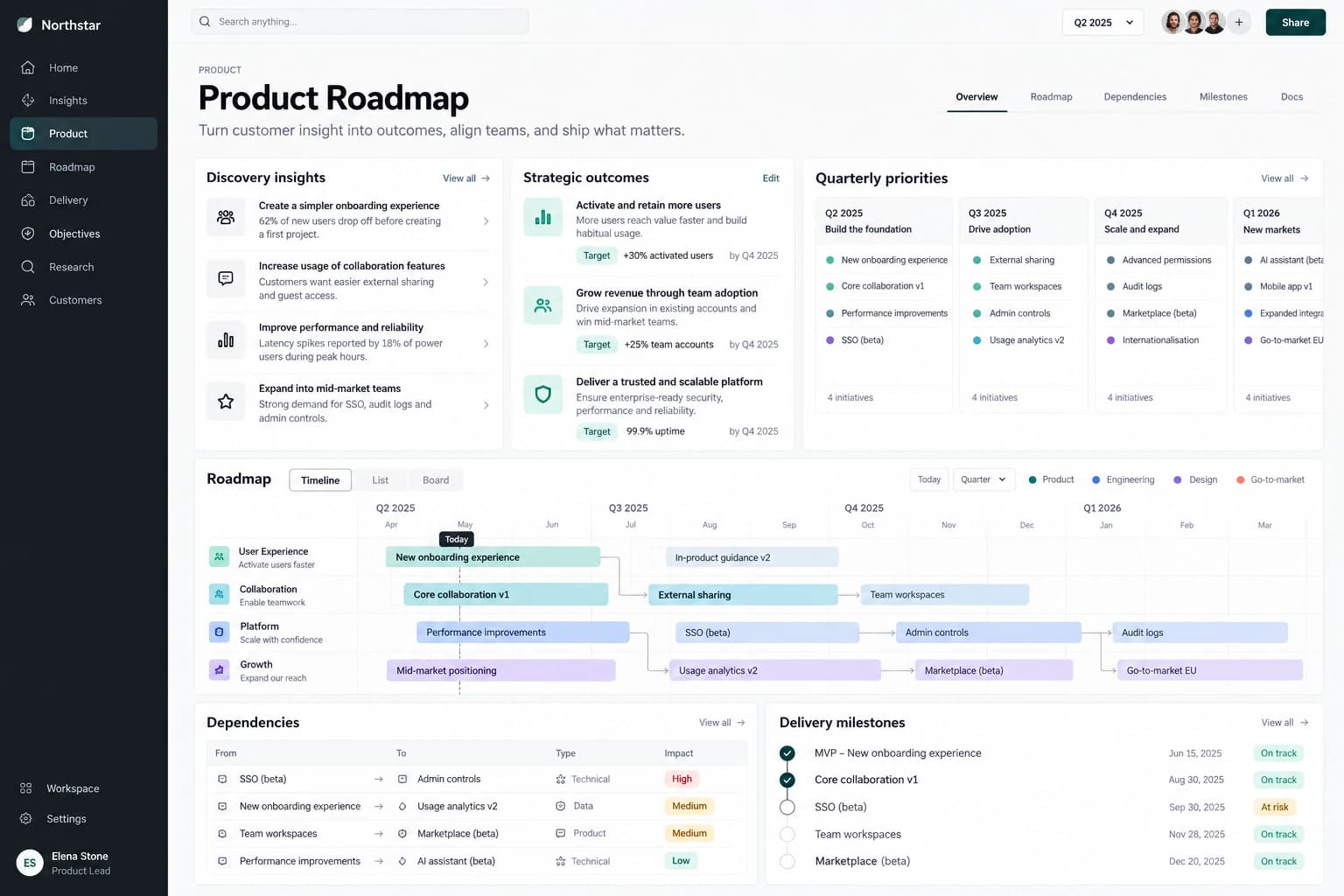
A roadmap should explain what the team will learn and deliver, not promise a fixed list of features months before the evidence exists. This approach works for a new SaaS product, an internal platform, or a customer portal.
Write the problem in the customer's language, identify the affected group, and establish a baseline. "Reduce time to approve a school application" is more useful than "build an admissions dashboard." Choose a small number of measures the team can influence.
Interview users, observe real work, and review analytics or support requests. Identify dependencies such as identity, payments, data access, compliance, and legacy integrations. Record assumptions that still need testing.
Prioritize a usable end-to-end path over a broad collection of unfinished features. Separate essential capabilities from improvements that can follow once users have tried the first release. Give each item a reason for its priority and an owner.
For each release, specify what will be measured, how feedback will be collected, and when the team will decide to continue, change direction, or stop. Keep delivery forecasts separate from desired outcomes. Review the roadmap when evidence or constraints change.
Include support, accessibility, security, content ownership, analytics, and maintenance in the roadmap. A feature is incomplete if the team cannot operate it reliably after launch.
The output can be a one-page plan: outcome, audience, current baseline, first complete journey, dependencies, release sequence, and next decision date.
Suppose the goal is to reduce the effort of booking an appointment. The first release might let a customer find availability, select a slot, receive confirmation, and change a booking. A reporting dashboard or loyalty feature may be valuable later, but neither fixes the core journey if availability is inaccurate or changes require a phone call.
For each opportunity, record the user problem, expected outcome, evidence, effort, dependencies, and risk of waiting. Compare options with the people who will operate the service. Do not treat a score as a decision maker; it reveals assumptions that need discussion. Flag work required for security, accessibility, data quality, and support even when it has no visible launch moment.
At each review, ask what shipped, what users actually did, what remains uncertain, and whether the next release still addresses the most important problem. Keep a record of decisions and changes so the roadmap remains a useful communication tool rather than a static promise.
A scoring matrix can make trade-offs visible, but a decimal score cannot remove uncertainty. Use evidence bands instead: observed customer pain, plausible benefit, delivery effort, dependencies, and risk. Mark assumptions that have not been tested. A high-value idea with unknown data access may need a small discovery task before it is scheduled as a release.
For an appointment service, a first release can support search, booking, confirmation, and cancellation. The next release might add reminders and self-service changes if evidence shows missed appointments or support calls. A later release could connect clinical preparation or payments. Each stage has an outcome to measure and an owner to decide whether the next stage still makes sense. Avoid labeling an unfinished backend or a set of isolated screens as a customer release.
Leadership needs outcomes, risk, and investment decisions. Delivery teams need scope boundaries, dependencies, and acceptance criteria. Support and operations need to know what will change for customers and how issues will be handled. Keep one source of truth, but present the relevant level of detail for each group. Make decision dates and owners visible.
A roadmap also needs time for reliability, accessibility, security updates, data cleanup, and removal of old paths. When a new feature replaces a process, set a date and criteria for retiring the old one. Otherwise the organization funds two ways of working indefinitely. Review the roadmap after each meaningful release and document what evidence changed the plan.
A practical WCAG-aligned website accessibility checklist for navigation, forms, content, responsive layouts, testing, and release ownership.
All articles ↗Compare synchronous APIs, event-driven messaging, and batch integration by latency, ownership, failure handling, data consistency, and operating cost.
All articles ↗Plan a secure cloud migration with dependency mapping, identity controls, backup rehearsal, cutover criteria, rollback, and post-migration ownership.
All articles ↗