

Applied AI in business: use cases and evaluation framework
A practical applied AI brief covering use-case selection, evaluation, human review, data boundaries, operating controls, and scale decisions.
All articles ↗ABT's 2026 digital delivery outlook covers accountable product ownership, controlled AI pilots, resilient platforms, and a practical planning exercise.
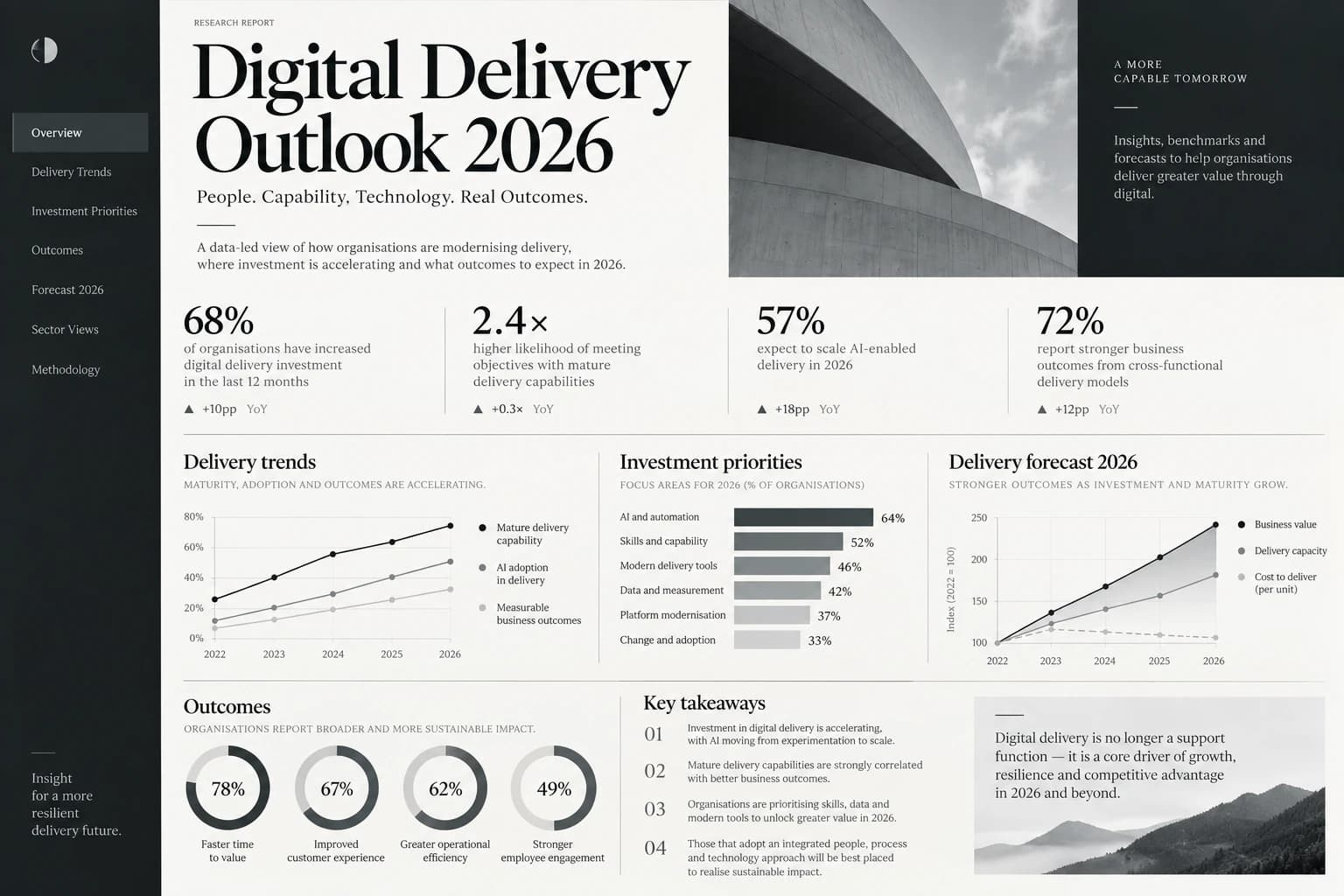
This outlook presents ABT Dev Services' practical priorities for digital delivery in 2026. It is an editorial view of patterns that product and technology teams should examine in their own organizations, rather than survey research.
When a customer journey crosses several departments, delays often have no single owner. Assign a person or team to the outcome from first contact through resolution. Give them authority to review content, process, data, and platform issues together. Measure the complete journey, not only the performance of one interface.
AI can help draft, classify, retrieve, and summarize information, but teams should define where a person checks the result and how errors are handled. Begin with narrow workflows where quality can be evaluated. The NIST AI Risk Management Framework provides a useful structure for governance, mapping, measurement, and management of risk.
Faster releases are useful only when the service remains dependable. Review integration ownership, observability, identity, accessibility, and recovery alongside new features. Retire redundant tools where they create conflicting data and unclear responsibility.
Select three high-value journeys. For each, write down the customer outcome, current friction, systems involved, owner, baseline measure, and next test. Choose one improvement that can be released and assessed in a short cycle. Revisit the plan as real user behavior and operational evidence arrive.
The strongest delivery strategy links a clear outcome to a small, measured release and an owner who can keep improving it.
Consider a customer service portal. Product ownership defines who is accountable for the entire request, not only the website. A controlled AI assistant may help staff find approved answers, but a person remains responsible for unusual or sensitive cases. Resilient integration ensures the customer and agent see a consistent request status. Treating these as separate initiatives can leave the handoffs unsolved.
For every proposed initiative, write down:
Prioritize work that resolves a complete journey and can be supported after release. Keep exploratory pilots separate from commitments that affect regulated or critical operations.
Technology and market conditions change, but the discipline of evidence remains. Review the portfolio quarterly with customer, operational, and financial information. Stop work that no longer has a clear outcome; expand work only when the result and operating model are understood.
This is an editorial assessment of delivery choices ABT sees as important, not a statistical industry survey. The priorities are selected because they influence whether digital work can be owned, evaluated, and operated after launch. Use them as prompts for your own portfolio review. They should not replace research with your customers, staff, systems, or market.
Take one end-to-end journey and write the responsible team beside every step. Include content, data, integrations, customer support, and exceptions. If a handoff has no owner or success measure, the experience can fail even when each component works. Assign a service owner with the authority to bring the right teams together. Define a baseline such as completion time or repeat contacts, then check whether releases improve it.
List existing tasks where AI could support a person, then compare a conventional improvement first. For a shortlisted task, document source data, allowed actions, quality test cases, human review, cost, and incident response. A pilot should have an explicit decision point. The NIST AI Risk Management Framework offers a governance structure, but the team must apply it to the actual use case.
Review a recent incident or difficult release. Could the team identify the affected user journey, roll back safely, and communicate status? Are key dependencies and data owners documented? Use this evidence to prioritize observability, recovery, and integration work. Reliability improvements should be tied to customer or operational consequences, not described only as technical housekeeping.
A company could select its customer onboarding journey, identify duplicated data entry, and establish one service owner. The first release might remove one handoff and provide a reliable status update. In parallel, an AI pilot could assist staff with approved internal guidance but remain under review. The quarter ends with evidence about task time, rework, and answer quality, not just a list of completed tickets.
These themes will not have equal priority in every organization. A team facing a security gap or contractual deadline should address that first. Start with one journey, gather baseline evidence, choose one accountable owner, and define a release and review date. Repeat the review each quarter as business conditions and user behavior change.
A practical applied AI brief covering use-case selection, evaluation, human review, data boundaries, operating controls, and scale decisions.
All articles ↗Assess product discovery, product pages, cart, checkout, and post-purchase service with a repeatable ecommerce UX scorecard.
All articles ↗Compare retain, improve, replatform, and rebuild options using service continuity, integration risk, data migration, ownership, and measurable outcomes.
All articles ↗