
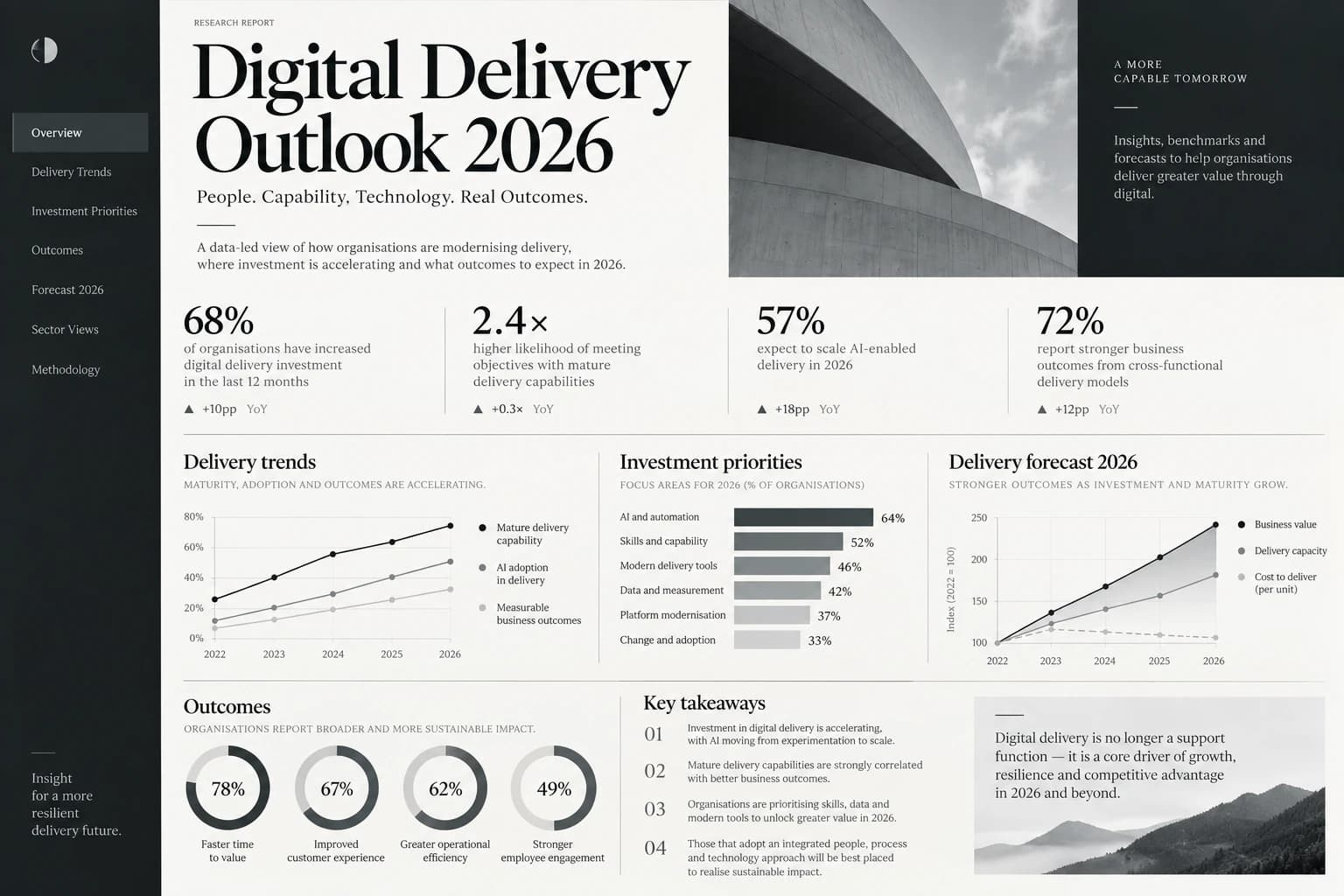
Digital delivery priorities for 2026: an agency outlook
ABT's 2026 digital delivery outlook covers accountable product ownership, controlled AI pilots, resilient platforms, and a practical planning exercise.
All articles ↗A practical applied AI brief covering use-case selection, evaluation, human review, data boundaries, operating controls, and scale decisions.
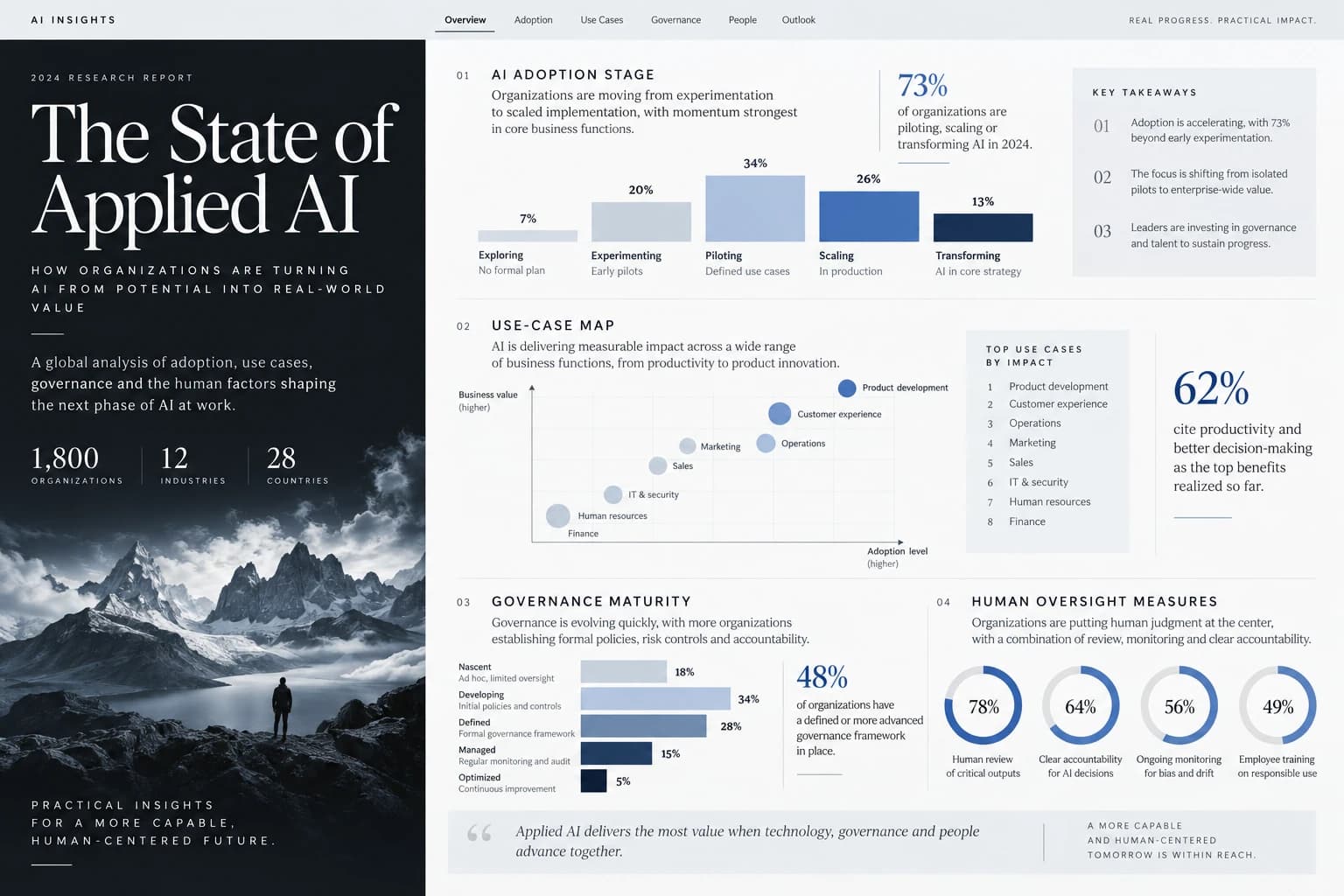
Applied AI is most useful when it improves a specific task with evidence that the output is good enough for that task. This brief is an implementation framework, not a market-size estimate or a survey of AI adoption.
For each use case, define the user, decision, source data, acceptable error, and harm from a wrong answer. Create a test set with routine, ambiguous, and high-risk examples. Compare the AI-assisted workflow with the current one on quality, time, correction effort, and cost. Include privacy and security review before real customer data enters a pilot.
Show when AI was involved. Give users a way to correct or challenge an output. Log version changes and monitor performance after release, because a model or source document can change. Set limits on which actions a system may take without approval.
The NIST AI Risk Management Framework offers a useful cycle of govern, map, measure, and manage. Apply it to the chosen workflow rather than treating a one-time launch review as sufficient. The question for every pilot is simple: did this make the work more dependable for the people doing it?
A support assistant could retrieve approved policy content and draft a response for an agent. To evaluate it, assemble real questions with personal data removed, include outdated and conflicting documents, and ask reviewers whether the answer is accurate, sourced, and safe to send. Measure time saved after correction, not just draft speed. Log cases where the assistant should say it does not know. Keep a clear route for an agent to escalate.
A search improvement, rule-based routing, or better content structure may solve the same problem with less uncertainty. Compare approaches on quality, maintenance, cost, and failure impact. Use AI where flexible language or pattern recognition adds value beyond a deterministic solution.
This framework helps a team invest in AI only when it improves a real workflow and can be operated responsibly.
For each proposed use case, record the current workflow, user, data source, decision, acceptable error, and cost of a wrong answer. Do not group all “AI opportunities” into one score. A drafting assistant and an automated decision engine have different risk and evaluation needs. Rank candidate tasks by business value, testability, and severity of failure, then select a limited pilot.
Create an evaluation set with representative examples, edge cases, and requests the system should refuse or escalate. Have qualified reviewers score output accuracy, source support, completeness, and correction effort. Record the model and prompt version so results can be reproduced. Compare with a simpler baseline, such as improved search or rules-based routing, using the same cases. A fast response is not useful if reviewers must rebuild it from scratch.
Decide which outputs are suggestions, which can be published after review, and which actions are prohibited without explicit approval. Make uncertainty and source material visible to the reviewer. Provide a correction path for users and monitor repeated failures. Log enough context to investigate an incident while limiting retention of sensitive data.
A legal or operations team may need summaries of long internal documents. A pilot should check whether material caveats are preserved, whether a summary cites the right source, and whether the system can say when the source is incomplete. It should not treat a fluent summary as proof of accuracy. Reviewers should compare output against the original document and record corrections. If the correction effort outweighs the benefit, improve retrieval, narrow the scope, or stop.
This framework does not rank vendors or claim market-wide adoption figures. Model behavior, provider policies, and applicable obligations can change, so a deployment requires current review of the chosen tools and context. The NIST AI Risk Management Framework is a useful general structure, not a substitute for use-case evaluation.
Select one workflow, establish a baseline, define a test set and an accountable owner, then run a limited pilot. Review quality, correction time, costs, and risks with the people who perform the work. Decide to stop, revise, or expand only after the evidence is documented.
ABT's 2026 digital delivery outlook covers accountable product ownership, controlled AI pilots, resilient platforms, and a practical planning exercise.
All articles ↗Assess product discovery, product pages, cart, checkout, and post-purchase service with a repeatable ecommerce UX scorecard.
All articles ↗Compare retain, improve, replatform, and rebuild options using service continuity, integration risk, data migration, ownership, and measurable outcomes.
All articles ↗